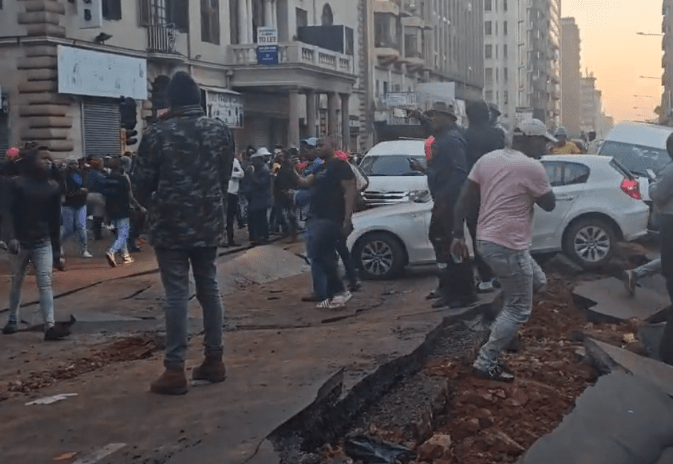
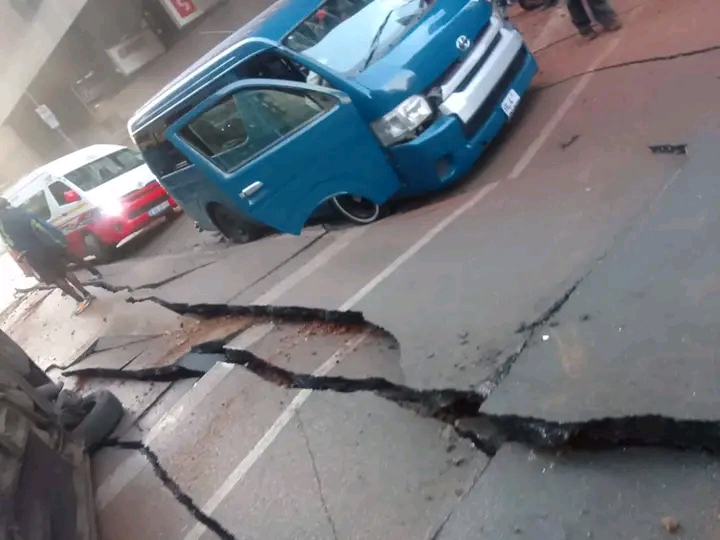
An official notice sent to community police forum groups said that an explosion had occurred, “possibly on the gas lines underground”.
“At this time we request the public to stay clear of the area to allow emergency services to attend to the scene. We will update as soon as more information is available,” the communique said.
Images from the scene showed how the road had been severely damaged, with tar ripped up. Several vehicles, including taxis which usually park along the busy public transport route, were damaged.
It was not immediately clear whether there were any injuries.
GOVERNMENT has announced that the issuance of visitors’ visas and residence permits for foreigners will now be supported by an integrated information communication technology system known as the Online Border Management System (OBMS).
The system, which is capable of sustainably handling demand for the services, resonates with the National Development Strategy One (NDS1) objective of modernising the economy through the use of ICTs and digital technology, as the country rallies towards the attainment of Vision 2030.
Government has engaged a Lithuanian company, Garsu Pasaulis to implement the system, which will help expedite the issuance of permits and visas.
Garsu Pasaulis already entered into a partnership with Government to produce e-passports that meet modern international standards and allow Zimbabweans to travel without additional complications. The passport system is being implemented on a build, operate and transfer (BOT) basis.
An ordinary e-passport, which costs US$120, takes seven working days to be processed while the emergency one costs US$220 and is out within 48 hours.In her post-Cabinet briefing yesterday, Information, Publicity and Broadcasting Services Minister Senator Monica Mutsvangwa said Government approved the engagement of Garsu Pasaulis to implement OBMS.
“Cabinet considered and approved the engagement of Garsu Pasaulis AUB on the implementation of an Online Border Management System incorporating visa and residence permits as proposed by the Minister of Home Affairs and Cultural Heritage, Honourable Kazembe Kazembe,” she said.Sen Mutsvangwa said Garsu Pasaulis is implementing the project to produce electronic passports based on biometric technology, including the roll-out of related services to all provinces.
“The remarkable transformation witnessed in the issuance of passports which has seen the backlog and queues wiped out in no time is testimony to Government’s due diligence and proficiency in engaging partners to implement projects,” she said.
The e-passport scheme was launched by President Mnangagwa in December 2021 after the Government entered into partnership with Garsu Pasaulis.
The switch-over to e-passports has helped eliminate the large backlog of application built-ups.
In addition, an online passport application system is set to be introduced to allow applications and payment for the documents online.
An electronic passport or e-passport contains an electronic chip, which holds the same information that is printed on the passport’s data page.
It contains the holder’s name, date of birth and other biographic information. An e-passport also contains a biometric identifier.
All of these features are designed to protect citizens from identity theft because it is difficult and expensive to steal the information stored on the document’s encrypted digital record. E-passports also allow for faster passage through border posts.
“Accordingly, Cabinet agreed to extend the Garsu Pasaulis contract to cover the implementation of national biometric infrastructure capable of producing entry visas and residence permits. The issuance of the visas and permits will be supported by an integrated information communication technology system capable of sustainably handling demand for the services,” said Minister Mutsvangwa.
Meanwhile, Minister Mutsvangwa also announced that the Ministry of Transport and Infrastructure Development in conjunction with the National Economic Consultative Forum will starting tomorrow until Friday host the 2nd Infrastructure Summit in Victoria Falls.
President Mnangagwa is expected to open the summit tomorrow.
The Summit will be held under the theme “Accelerating Transport Infrastructure Projects Development in Zimbabwe: Towards World-Class Transport Networks by 2030”.
Minister Mutsvangwa said special attention will be given to the three modes of transport infrastructure in Zimbabwe, namely: road, rail and air.
Various players in the country’s infrastructure development sector are attending the two-day event which comes at a time when the Second Republic is working hard towards economic transformation through developments in key sectors such as infrastructure development, manufacturing, agriculture and mining.The inaugural Infrastructure Summit was also held in Victoria Falls last year in September.
LEADING telecoms company, Econet Wireless Zimbabwe upgraded 70 percent base station sites in Bulawayo in the period ending 31 May as it also plans to upgrade the radio network in Bulawayo and other cities.The firm which last week celebrated its 25th anniversary said its capital expenditure programme, which continues to be constrained by unavailability of foreign currency to pay suppliers over the next 12 months, is expected to be about US$135 million.
It launched its mobile network on July 10, 1998 and was subsequently listed on the Zimbabwe Stock Exchange on September 17 of the same year.
The firm which last week celebrated its 25th anniversary said its capital expenditure programme, which continues to be constrained by unavailability of foreign currency to pay suppliers over the next 12 months, is expected to be about US$135 million.
It launched its mobile network on July 10, 1998 and was subsequently listed on the Zimbabwe Stock Exchange on September 17 of the same year.
In a trading update for the quarter ended 31 May 2023, Econet noted that it is in the process of implementing a virtualised core network that will replace the current core network system.
The core network is the nerve centre of all the complex network activities that take place in providing the services we provide to our customers.
“This upgrade will enable the company to launch additional products and services and implement faster product changes to enhance the customer experience.
“We also plan to upgrade our radio network in Harare, Bulawayo and Manicaland by the end of the 2023 calendar year. For the period under review, the business upgraded 30 percent of our Harare and 70 percent of the Bulawayo base station sites,” it said.
Econet said as a result of the upgrades, it has seen an increase in the speed and volume of data consumed by usage of voice and data for the quarter under review grew by 30 percent and 31 percent respectively.
“This increase in volumes requires further investment into the platforms and systems that drive network capacity and capabilities. Our capital expenditure programme which continues to be constrained by lack of availability of foreign currency to pay our suppliers over the next 12 months is expected to be about US$ 135 million.
“This capital expenditure will require a supportive pricing regime given the inflation trends and currency depreciation.”
In inflation adjusted terms, Econet noted an increase of revenue for the quarter of 137 percent compared to the same period last year.Meanwhile, the firm has approved a renounceable rights offer to raise US$30.3 million to be applied towards redemption of our maturing debentures.
A renounceable right is an offer issued by a corporation to shareholders to buy more shares of the company’s stock, usually at a discount
The Zimbabwe Republic Police have made a second arrest in connection with the E-Creator Ponzi scheme. Trymore Tapfumaneyi, one of the directors of the company, was taken into custody on 13 July 2023 for fraud involving the scheme. This development follows the closure of E-Creator in July 2023 after it allegedly disappeared with over $1 million of its members’ money. This arrest comes shortly after the arrest of alleged mastermind Zhao Jiaotong.What was E-Creator? E-Creator was registered as a legal private company under the Companies and City Council’s acts, accompanied by a Zimra number. The company claimed to be an e-commerce company that partnered with platforms such as Lazada and Zalando. It offered various packages that required members to pay a registration fee ranging from US$15 to US$300 and then post fake positive reviews on these platforms.The merchants allegedly paid the company promotion fees, and the employees who completed the work allegedly earned commission income. This business model and the high-interest rates of 4 percent per day attracted many investors and customers to E-Creator.
From Rags To Riches And Back To Rags: Vendor Strikes Gold With Huge Betting Win Only To Fall Victim To Armed Robber What Happened to E-Creator? E-Creator closed down in July 2023, after just two months of operation, due to the alleged disappearance of its founder, Zhao Jiaotong, who was a Chinese national. The scheme scammed thousands of people in Zimbabwe who had invested their hard-earned money in the hope of making some extra income.
Who is Trymore Tapfumaneyi? Trymore Tapfumaneyi is one of the directors of E-Creator and has been arrested for fraud involving the Ponzi scheme. The Zimbabwe Republic Police made the arrest on 13 July 2023, and Tapfumaneyi is currently in custody. In a tweet, the police said,The ZRP confirms the arrest of Trymore Tapfumanei (32) on 13/07/23 for Fraud involving E-Creator ponzi scheme. The suspect is one of the directors of E-Creator.
The police are yet to provide more details following the arrests of Zhao Jiaotong and Trymore Tapfumaneyi.
FIRST BLACK CRICKTER OF ZIMBABWE. Henry Olonga made his debut as the first black international cricketer of Zimbabwe at the age of 18 in 1995. Representing Zimbabwe for over 7 years, he played 80 international games and claimed 126 wickets.
Born in Zambia and holding Kenyan nationality, Olonga’s father initially wanted him to represent Kenya in the Olympics, but he chose to pursue a cricketing career instead. By giving up his Kenyan nationality, he became the youngest Zimbabwean cricketer at the time. Interestingly, Olonga’s debut game against Pakistan also marked Zimbabwe’s first Test win.
During Zimbabwe’s second Test win, which was against India, Olonga was awarded the man of the match for his first innings figures of 5 for 70. In an ODI game against England in 2000, he achieved remarkable figures of 6 for 19, which still stands as the best ODI bowling figures by a Zimbabwean bowler. One of his most memorable ODI performances came during a 1999 World Cup game against India when he took 3 wickets in the final over, securing Zimbabwe’s first World Cup win against India by a narrow margin.
Unfortunately, Olonga’s international career came to an end at the age of 26. Not long after, he retired from all forms of cricket due to a knee injury.
Since retiring from cricket, Henry Olonga has pursued a career in music. Despite facing adversity and controversy during his cricketing days, he remains a prominent figure in Zimbabwe’s cricket history, especially during their best days in international cricket.
Mashudu Netsianda is appealing for funds to enable his three-month-old baby to undergo open heart surgery in India.
The baby was born with a congenital heart defect called Tetralogy of Fallot (TOF), a birth defect that affects normal blood flow through the heart.
It happens when a baby’s heart does not form correctly as the baby grows and develops in the mother’s womb during pregnancy.
Doctors say the baby has to undergo a surgical operation in India before turning 12 months old, at the latest, to avoid health complications.
The procedure costs between US$15 000 and US$20 000 inclusive of air tickets and accommodation. Said Netsianda:
My son was born with a congenital heart defect, which requires open heart surgery.
Presently, the surgery is not available in Zimbabwe, and I am therefore appealing for financial assistance to raise money for the required procedure in India.
From the quotations that we did, the treatment cost of this critical operation has been pegged at between US$7 000 and US$10 000 excluding accommodation and air tickets, which all in all get around US$15 000 depending on the hospitals.
Well-wishers can use the following banking details:
Banking details Mashudu Netsianda FBC Bank Nostro Account 6020247140714 Branch Jason Moyo Bulawayo
RTGS Banking details 3020247140714 FBC Jason Moyo Bulawayo.
Please before you send any money please call the father with the below number
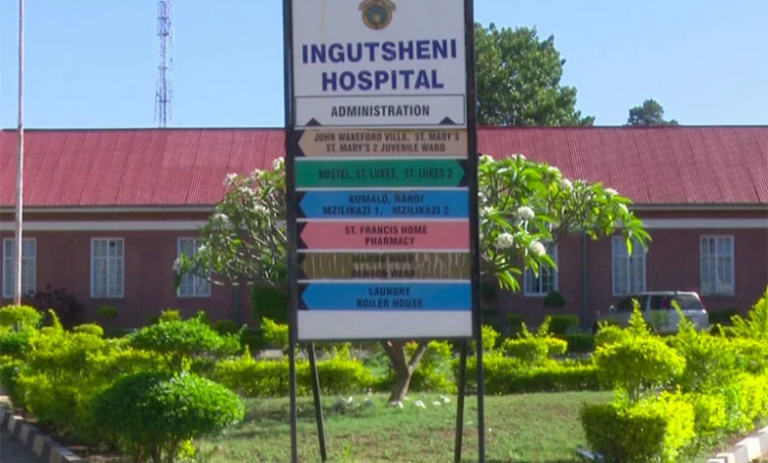
BULAWAYO’s Ingutsheni mental hospital has become overcrowded, triggering a serious shortage of blankets. A Bulawayo resident, who recently visited the health institution to see a relative, said the situation was dire.“There is Khumalo ward which is an admission ward for male patients. They are overpopulated in that ward. It was designed for only 98 patients, but when I visited the hospital with some ladies, we heard that there are at least 270 inmates,” the resident said.Ingutsheni Hospital chief executive officer Nemache Mawere confirmed the overcrowding at the institution’s male ward. Mawere said they had no idea how the number shot beyond the hospital’s carrying capacity.
“We used to have around 150 inmates in the ward and we do not even know how the figure shot up to that,” Mawere said.
“I think we need to engage the communities where the inmates are coming from to find out what’s happening. We cannot dump our problems at the hospital.”
He said the hospital did not only cater for patients from Bulawayo, but also from across the country. The institution is the largest referral centre for mental patients in Zimbabwe. Mawere also confirmed the blanket shortage at the institution, but said this was because inmates were in the habit of tearing them.
Reports late last year indicated the mental hospital was experiencing an increase in patients affected by alcohol, drug and substance abuse. In April last year, government launched a Zimbabwe National Drug Master Plan which identified alcohol and drug abuse as one of the top causes of mental health problems in the country’s 10 provinces.Source
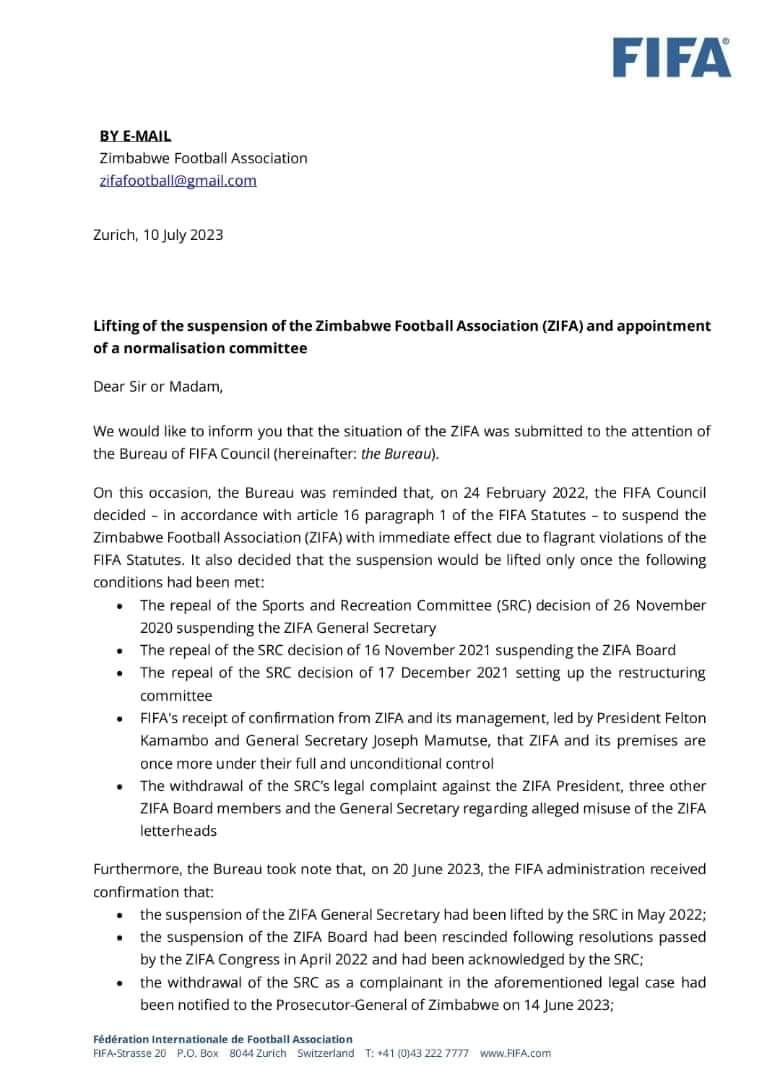
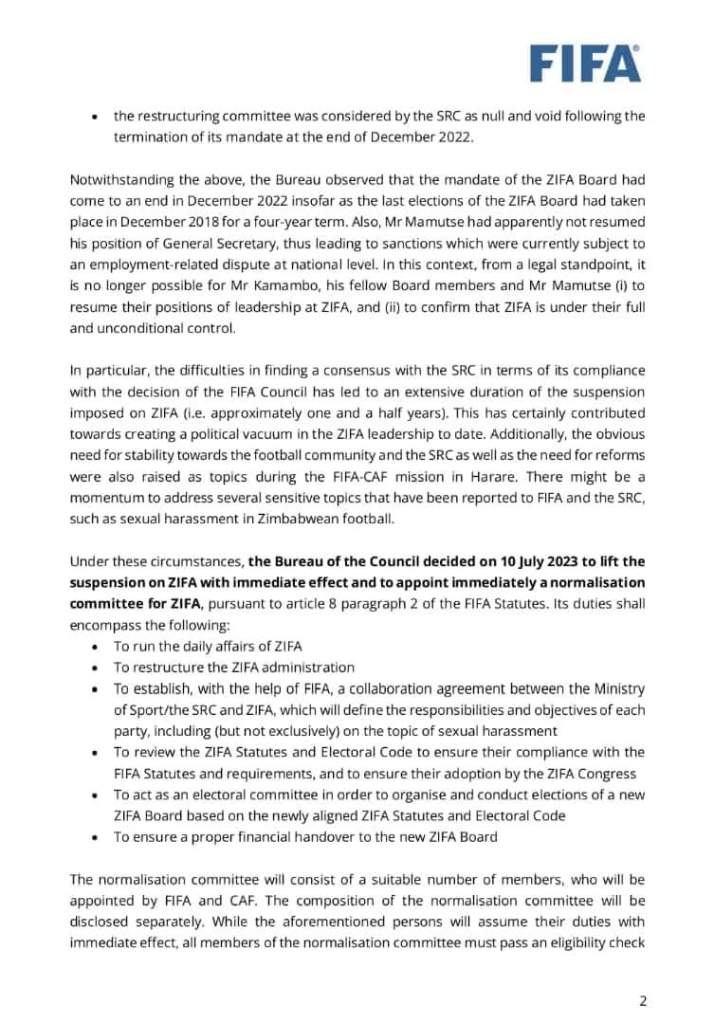
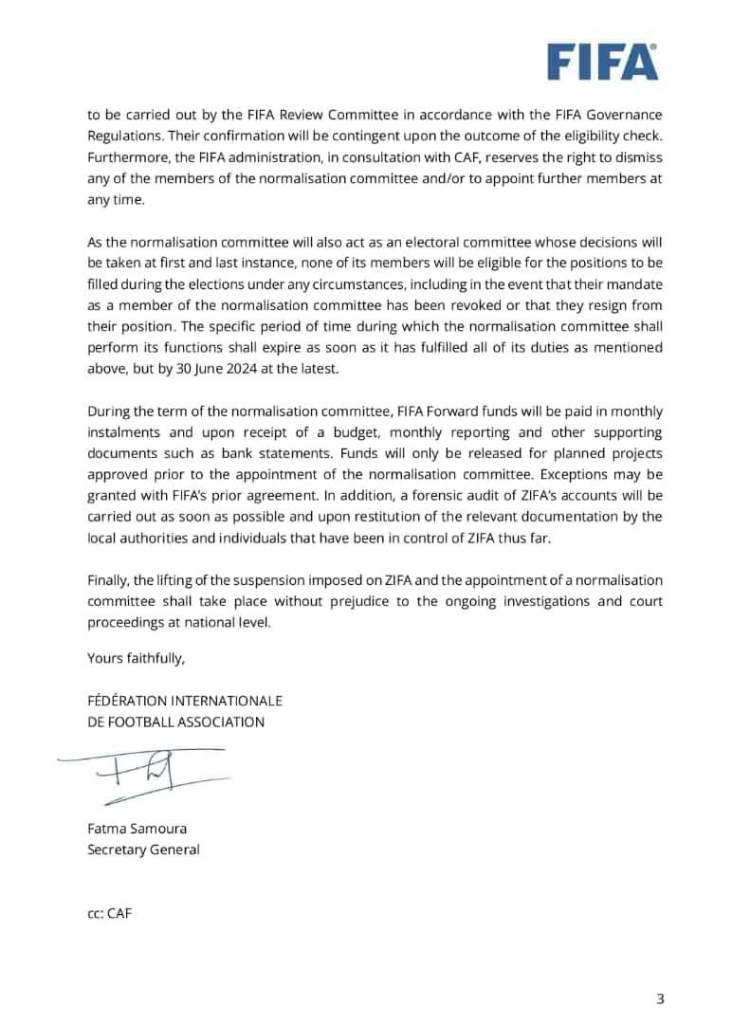
FIFA lifts ban on Zimbabwe, appoints ‘normalisation committee’ for a year
+ Decision comes after SRC lifts Felton Kamambo board suspension – but because their term has expired, FIFA concedes they cannot resume control at ZIFA
The Ndhlela Nhire Dynasty Family Trust solo cyclist Calvin Mzimukulu managed to complete a Harare to Masvingo anti-drugs campaign cycling tour in a record 12 hours on June 29, 2023. Mzimukulu started the race at 0500hrs from Harare’s main post office and arrived in Masvingo at exactly 1700hrs before he proceeded to Bikita’s Hanyanya Mountain the following day.Mzimukulu said drugs are destroying the youths therefore, he took it upon himself to cycle from Harare to Masvingo and then Bikita raising awareness on the negative impacts of drugs.
“I started the journey at 0500hours and arrived at 1730hours. My objective is to raise awareness on the negative impact of drugs as well as encouraging the youths to take cycling as a sport. The tour is aims to market Hanyanya Mountains in Bikita as a safe tourist destination where tourists from across the world can visit,” said Mzimukulu.“I am challenging the youths to take sport seriously and desist from taking drugs and spending most of their time sitting on bridges, there are a lot of celebrities who are making a living through sporting. To the youth I say, age is just a number and it is never too late for someone to start cycling,” he added.
He said they were going to have a similar tour next year and hoped to get more cyclists as next year’s programme is targeting cultural exchanges with cultural exchange programs. Hanyanya Mountain is iconic and home to the Mtombe people and its popularly known for producing the edible stink bugs (Harurwa).
The power utility, Zesa, says the country no longer needs a load-shedding schedule as it is now able to produce enough electricity from its power plants with minimal imports to meet demand by domestic and industrial consumers. The successful implementation and completion of Hwange Thermal Power Station Units 7 and 8 expansion projects, which are now undergoing the final synchronisation phase, coupled with the establishment of solar parks by Independent Power Producers (IPPs) and improved output from Kariba Hydro-Power Station, has recently pushed total domestic generation capacity above 1 500MW on average when compared to less than 600MW in March this year.
The improved power generation capacity has drastically reduced load-shedding across the country and excited the productive sector, which is now able to plan operational schedules and guarantee smooth industry outcomes.
Yesterday, the Zimbabwe Power Company (ZPC) in its daily update indicated that total power generated stood at 1 443MW with Kariba producing 875MW, Hwange adding 535MW, and Harare and Munyati thermal power stations contributing 21MW and 12MW respectively.
In line with its infrastructure and utilities priority projects, the Second Republic has committed a lot of resources towards increasing power generation hence the benefit now being enjoyed by industry and domestic consumers. Captains of industry and commerce believe the improved electricity supply in the country is a key deliverable for economic growth as it will boost production, increase capacity utilisation and reduce production costs. Due to load shedding several businesses had opted for expensive diesel generators and those who did not would incur long hours of no production.
In a recent interview in Bulawayo, Zimbabwe Energy Transmission and Distribution Company (ZETDC) acting managing director, Engineer Howard Choga, said given the milestone improvement in power generation and supply, there is no need for a load-shedding schedule.
“You will notice that in the past two to three weeks, we have not been shedding at all, therefore, under those circumstances, there will be no need to have a load-shedding schedule,” he said.
“Our projection is that we are not going to be shedding going forward, at least in the medium term,” said Eng Choga, adding. “If we are not shedding it means we are getting enough for the consumers.”
On imports, Eng Choga said: “At the moment we are getting 100 megawatts from South Africa, and from Mozambique, we have two sources that is Hidroeléctrica de Cahora Bassa (HCB) of Mozambique, which is giving us 50MW and EDM 10MW. That’s enough for the demand in the country”.
With improved power generation, the business community has started feeling the positive impact expressing hope that the situation will continue to stabilise, thereby guaranteeing enhanced production and supply of goods. This is a significant departure from the acute power shortages experienced in the past years, which have crippled production across various sectors of the economy while the use of generators as an alternative source of energy was said to be costly and not sustainable.
Last week, Energy and Power Development Permanent Secretary, Dr Gloria Magombo, said the coming in of Units 7 and 8 in Hwange, which are undergoing technical commissioning ahead of commercialisation, have greatly improved the power situation. Built at a cost of about US$1,5 billion, the Hwange Thermal Power Station Unit 7 and 8 expansions, is one of the Second Republic’s signature projects aimed at boosting power generation.
Unit 7 and 8 will provide a combined 600MW to about 1 500MW being produced from major thermal and hydro projects. It is one of the flagship projects being implemented under the Second Republic in line with Vision 2030, which aims to transform Zimbabwe into an upper-middle-income economy.The country’s economy is on a rebound due to various policies initiated by the Government that have seen growth in the mining and agricultural sectors.
Several other power generation projects are at various stages of implementation. Added to that, a steadily growing population, rapid rural-to-urban migration, and nascent economic recovery — driven by new mining projects — have spurred demand for power in the country.







 THE MASHUP WITH JACOB 🇿🇼